Files
Download Full Text (4.1 MB)
Description
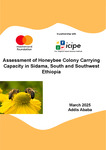
Apiculture remains the primary economic activity for Mass Youth Employment in Apiculture (MaYEA)’s youth partners in Ethiopia, and estimating the honey flow period is essential for effective beekeeping operations. Identifying and understanding the distribution and flowering patterns of bee forage plants enables beekeepers to synchronize colony management practices with the peak availability of nectar and pollen to achieve increased honey yields and improved quality of honey. Thus, optimizing floral resource use and ensuring sustainable honey production require a clear understanding of vegetation-based honey production potential and an area's honeybee colony carrying capacity. In response to this need, the International Centre of Insect Physiology and Ecology (icipe), in collaboration with the Mastercard Foundation, Ethiopian Relief Organization (ORDA Ethiopia), International Institute of Rural Reconstruction (IIRR), and other implementing partners, conducted a comprehensive assessment in 20 MaYEA intervention woredas located in the South, Southwest, and Sidama regions of Ethiopia.
Publication Date
2025
Publisher
International Centre of Insect Physiology and Ecology (icipe)
City
Addis Ababa, Ethiopia
Recommended Citation
icipe (2025). Assessment of Honeybee Colony Carrying Capacity in Sidama, South and Southwest Ethiopia. International Center of Insect Physiology and Ecology (icipe), Addis Ababa, Ethiopia. https://thehive.icipe.org/manuals/29/