Files
Download Full Text (24.1 MB)
Description
Foreword
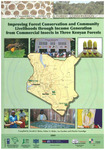
The aim of this project was to strengthen the protection of three different forest reserves in Kenya by improving incentives to adjacent communities for them to collaborate in forest management. Such incentives are most effective when they are based on sustainable use of forest biodiversity, since this gives local communities a direct stake in forest conservation without threatening the resource base. Commercial insects (like bees and silkmoths) are ideal for this purpose. They give quick rewards, use renewable resources (nectar, pollen and leaves), and are technically relatively simple and easily adopted. In the case of bees, there are also positive synergies resulting from their pollination activities in both the forests and adjacent farmland.
The project activities were designed to link bee keeping and silk production to Participatory Forest Management (PFM) initiatives in Kenya. PFM has become widely accepted as an effective mechanism for forest conservation, but it suffers from a lack of incentives for community involvement. This problem is exacerbated when conservation requires reduced extraction of forest products such as timber, poles and fuelwood. Commercial insect enterprises can compensate for this foregone resource use and provide an incentive for local communities to engage in forest management. They are particularly suitable for use in buffer zones around protected forests.
In this context, the project provided (i) support for conservation of forest-protected areas through improved buffer zone management by local communities; and (ii) improved livelihoods of forest adjacent communities through the commercial use of insect resources, linked to forest habitats.
These strategies were used to strengthen the community forest associations, and forest managers in the target sites. All these efforts were coordinated at the project steering committee and tripartite review meetings by the multiple stakeholders.
The project has demonstrated the effectiveness of this approach to development and forest conservation. We look forward to the mainstreaming of commercial insect activities throughout the forest sector in Africa.
Christian Borgemeister Director General icipe
ISBN
92 9064 208 4
Publication Date
2009
Publisher
International Centre of Insect Physiology and Ecology (icipe)
Recommended Citation
Raina, S. K., Kioko, E. N., Gordon, I., Nyandiga, C., Muli, E., Nguku, E., & Wang’ombe, E. (2009). Improving Forest Conservation and Community Livelihoods through Income Generation from Commercial Insects in Three Kenyan Forests. Retrieved from https://thehive.icipe.org/manuals/22