Files
Download Full Text (39.7 MB)
Description
Preface
When the African Regional Postgraduate Programme in Insect Science (ARPPIS) was established at the International Centre of Insect Physiology and Ecology (ICIPE) Nairobi, Kenya in 1983, the main objective was to strengthen the capabilities of African universities in postgraduate training in arthropod science, using technical expertise and the advanced research facilities already existing at the ICIPE. The multidisciplinary setting of ICIPE’s research programme enables ARPPIS to admit students from a variety of training backgrounds, not limited to entomology. Thus, the programme also admitted graduates of basic sciences such as mathematics and chemistry, who wished to apply their disciplines to the study of arthropod populations and behaviour.
In order to prepare ARPPIS students for research in arthropod science, it became apparent that the students should first be brought to a reasonable and more uniform level of understanding of basic arthropod science before they embarked on their thesis work. It was, therefore, decided that the ARPPIS course-work should include a mandatory taught semester containing six graduate-level courses, to be taught by some of the best-known authorities in each discipline. The selected six courses were: insect functional morphology; insect physiology and biochemistry; insect taxonomy; insect ecology; biological control of arthropod pests; and biomathematics and experimental design.
Experience from the ARPPIS taught semesters revealed the deficiency of relevant text books and manuals for the intensive teaching programme. Most urgent was the need for a laboratory teaching manual on insect functional morphology, which is the backbone to the understanding of all other aspects of insect science and its application. In the early 1990s, the ARPPIS Academic Board took a decisive stand; that the programme had to produce its own training manuals and reference text books relevant to the special needs of its curriculum. The ICIPE promptly took this challenge and commissioned professional experts in the various disciplines to start work on training materials; and there could be no better choice of experts than those who had hands-on experience with the ARPPIS taught courses.
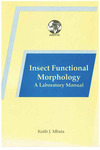
The author of Insect Functional Morphology Laboratory Manual, Dr Keith Japhet Mbata, is head of Biological Sciences Department at the University of Zambia, Lusaka. His association with ARPPIS programme started in 1989 when he took over responsibility for teaching insect functional morphology to ARPPIS Ph.D. students. His predecessor was Professor El Amin El Rayah of the Department of Zoology, Faculty of Science at the University of Khartoum, who coordinated the course from 1985 to 1988. Another lecturer on the course during Dr Mbata’s time was Dr Walter Jura, who was a research scientist at ICIPE; he also assisted in reviewing the initial manuscripts of this manual.
Work on the preparation of this manual started in 1991, when Dr Mbata accepted the assignment from Professor Thomas R. Odhiambo, then director of ICIPE. The intention was for Dr Mbata to complement his vast knowledge of the subject with specific experiences on the ARPPIS programme, and to incorporate into the manual suitable instruction materials which had been accumulated by the programme over a long period. This was no mean task, however; for a good quality manual the information had to be thoroughly researched, and fresh laboratory preparations and displays of morphological structures had to be undertaken in order to produce suitable illustrations for the manual. We note with great satisfaction that the work has been expertly executed, and an instruction guide of rare quality has been assembled.
This manual is intended specifically for graduate students of tropical entomology, although the depth and breadth of its coverage also makes it appeal to young scientists from other parts of the world. It is a laboratory manual designed for use in practical instruction, but could also be a useful contribution to a reference collection for researchers and diagnostic laboratories. In the ARPPIS programme, the material covered in the manual forms a mandatory course-work in insect functional morphology, required at the M.Sc. level. The manual will be of particular use in the ARPPIS Sub-Regional M.Sc. Programme which is currently hosted by three Sub-Regional Centres: Biological Sciences Department, University of Zimbabwe, Harare (M.Sc. in Tropical Entomology - MTE); Department of Crop Science, University of Ghana, Legon (M. Phil. Insect Science); and Department of Biology, Addis Ababa University (M.Sc. Insect Science). Other universities with graduate-level course-work in insect science are welcome to use the manual in their programmes.
Financial support for the production of the manual was provided by the Netherlands Government, through their “Direct Support to Training Institutes in Developing Countries (DSO)”, as part of a training project grant to ARPPIS through ICIPE. We are grateful to the DSO for their unwavering support to the ARPPIS programme; another manual of this series produced with DSO support is Techniques of Insect Rearing for the Development of Integrated Pest and Vector Management Strategies, Volumes 1 and 2 (Edited by J.P.R. Ochieng-Odero). Both manuals have been widely circulated to universities in Africa for use in graduate training programmes; inquiries for additional copies may be sent to ICIPE Science Press.
The ARPPIS programme is indebted to all individuals and institutions whose efforts and all forms of contribution made it possible to produce Insect Functional Morphology Laboratory Manual. We congratulate Dr Keith Mbata on this excellent achievement.
Vitalis O. Musewe, Ph.D.
Publication Date
1997
Publisher
ICIPE Science Press, International Centre of Insect Physiology and Ecology (icipe)
Recommended Citation
Mbata, K. J. (1997). Insect Functional Morphology: A Laboratory Manual. Retrieved from https://thehive.icipe.org/manuals/4