-
Insect Functional Morphology: A Laboratory Manual
Keith J. Mbata
Preface
When the African Regional Postgraduate Programme in Insect Science (ARPPIS) was established at the International Centre of Insect Physiology and Ecology (ICIPE) Nairobi, Kenya in 1983, the main objective was to strengthen the capabilities of African universities in postgraduate training in arthropod science, using technical expertise and the advanced research facilities already existing at the ICIPE. The multidisciplinary setting of ICIPE’s research programme enables ARPPIS to admit students from a variety of training backgrounds, not limited to entomology. Thus, the programme also admitted graduates of basic sciences such as mathematics and chemistry, who wished to apply their disciplines to the study of arthropod populations and behaviour.
In order to prepare ARPPIS students for research in arthropod science, it became apparent that the students should first be brought to a reasonable and more uniform level of understanding of basic arthropod science before they embarked on their thesis work. It was, therefore, decided that the ARPPIS course-work should include a mandatory taught semester containing six graduate-level courses, to be taught by some of the best-known authorities in each discipline. The selected six courses were: insect functional morphology; insect physiology and biochemistry; insect taxonomy; insect ecology; biological control of arthropod pests; and biomathematics and experimental design.
Experience from the ARPPIS taught semesters revealed the deficiency of relevant text books and manuals for the intensive teaching programme. Most urgent was the need for a laboratory teaching manual on insect functional morphology, which is the backbone to the understanding of all other aspects of insect science and its application. In the early 1990s, the ARPPIS Academic Board took a decisive stand; that the programme had to produce its own training manuals and reference text books relevant to the special needs of its curriculum. The ICIPE promptly took this challenge and commissioned professional experts in the various disciplines to start work on training materials; and there could be no better choice of experts than those who had hands-on experience with the ARPPIS taught courses.
The author of Insect Functional Morphology Laboratory Manual, Dr Keith Japhet Mbata, is head of Biological Sciences Department at the University of Zambia, Lusaka. His association with ARPPIS programme started in 1989 when he took over responsibility for teaching insect functional morphology to ARPPIS Ph.D. students. His predecessor was Professor El Amin El Rayah of the Department of Zoology, Faculty of Science at the University of Khartoum, who coordinated the course from 1985 to 1988. Another lecturer on the course during Dr Mbata’s time was Dr Walter Jura, who was a research scientist at ICIPE; he also assisted in reviewing the initial manuscripts of this manual.
Work on the preparation of this manual started in 1991, when Dr Mbata accepted the assignment from Professor Thomas R. Odhiambo, then director of ICIPE. The intention was for Dr Mbata to complement his vast knowledge of the subject with specific experiences on the ARPPIS programme, and to incorporate into the manual suitable instruction materials which had been accumulated by the programme over a long period. This was no mean task, however; for a good quality manual the information had to be thoroughly researched, and fresh laboratory preparations and displays of morphological structures had to be undertaken in order to produce suitable illustrations for the manual. We note with great satisfaction that the work has been expertly executed, and an instruction guide of rare quality has been assembled.
This manual is intended specifically for graduate students of tropical entomology, although the depth and breadth of its coverage also makes it appeal to young scientists from other parts of the world. It is a laboratory manual designed for use in practical instruction, but could also be a useful contribution to a reference collection for researchers and diagnostic laboratories. In the ARPPIS programme, the material covered in the manual forms a mandatory course-work in insect functional morphology, required at the M.Sc. level. The manual will be of particular use in the ARPPIS Sub-Regional M.Sc. Programme which is currently hosted by three Sub-Regional Centres: Biological Sciences Department, University of Zimbabwe, Harare (M.Sc. in Tropical Entomology - MTE); Department of Crop Science, University of Ghana, Legon (M. Phil. Insect Science); and Department of Biology, Addis Ababa University (M.Sc. Insect Science). Other universities with graduate-level course-work in insect science are welcome to use the manual in their programmes.
Financial support for the production of the manual was provided by the Netherlands Government, through their “Direct Support to Training Institutes in Developing Countries (DSO)”, as part of a training project grant to ARPPIS through ICIPE. We are grateful to the DSO for their unwavering support to the ARPPIS programme; another manual of this series produced with DSO support is Techniques of Insect Rearing for the Development of Integrated Pest and Vector Management Strategies, Volumes 1 and 2 (Edited by J.P.R. Ochieng-Odero). Both manuals have been widely circulated to universities in Africa for use in graduate training programmes; inquiries for additional copies may be sent to ICIPE Science Press.
The ARPPIS programme is indebted to all individuals and institutions whose efforts and all forms of contribution made it possible to produce Insect Functional Morphology Laboratory Manual. We congratulate Dr Keith Mbata on this excellent achievement.
Vitalis O. Musewe, Ph.D.
-
Insect Physiology and Biochemistry - ICIPE-PEW Manual Series
M.F.B Chaudhury
Preface
The Manual for INSECT PHYSIOLOGY AND BIOCHEMISTRY has been expressly prepared for the insect physiology course given by the African Regional Postgraduate Programme in Insect Science (ARPPIS) at the International Centre of Insect Physiology and Ecology (ICIPE), Nairobi, Kenya. Although the manual is specifically written for the ARPPIS course, it will be useful for similar courses given at other institutes and universities in Africa and elsewhere.
The objectives of the insect physiology course are to give the students an understanding of the principles of insect physiology through discussions on classic and current research on structures and functions and to familiarize the students with various research methodology which are applied in the research of insect physiological problems.
The manual is divided into two sections: Lectures and Practicals. The lecture section presents synopses of 30 lectures of 15 general topics of insect physiology and biochemistry. These synopses are for the purpose of guidance only. On each lecture topic, the students will receive additional materials from the instructor, including handouts on figures, data, graphs, etc., references for additional reading, current research activities in the field and relevant research methodology. The practical section includes 40 exercises for both laboratory and field. During any one teaching term, the students will work on only 10 or 12 of these exercises. In addition, there will be opportunity to take up independent individual research projects by the students, which may last for the entire teaching term.
A major aim of this course will be to use, wherever possible, examples of tropical insects and the students will work, both in the field and the laboratory, on insects which are important in the tropics.
Because a number of areas in insect physiology and biochemistry are important and interesting from the point of active research in many laboratories around the world, knowledge in these areas are accumulating quickly. This will necessitate frequent revision of this manual, particularly in terms of additional references on new research findings. In spite of this fact, this manual will no doubt serve the students and the instructors effectively for four or five years.
M. F. B. CHAUDHURY Nairobi, Kenya December 1991
-
Insect Population Ecology: An African Perspective
Joseph S. Elkinton
PREFACE
The purpose of this text is to introduce the fundamentals of insect population ecology with a focus on African insects and related arthropods such as mites. The impetus to prepare such a text arose from the graduate course in insect population ecology offered by the African Regional Postgraduate Program in Insect Science (ARPPIS) conducted at the International Center of Insect Physiology and Ecology (ICIPE) in Nairobi, Kenya. The goal of the text is to introduce the students to the basic concepts of insect population ecology. The emphasis is on quantitative methods that students are likely to apply in their field research. The text assumes that students have had a basic training in statistical inference. At the end of each chapter is a set of exercises designed to give the students practice with the material on the chapter. I believe that such practice is critical in helping students master the material and overcome any fears they might have of complex numerical calculations.
I wish to thank the many individuals who have assisted with this project, especially Jeff and Cindy Boettner who made most of the figures and helped with the editing and all phases of the final preparation. I am grateful to Karin Fischer, Gloria Witkus, Rolf Fishburn-Parker Amy Musante, Allan Wright and Don Wakuluk, who helped with gathering references; Sam Englestadt, Zbigniew Dabrowski, Brian Williams, John Edman and Dave Leonard who assisted in logistical support and helped establish the many contacts required to prepare this text. Paula Martin and the ARPPIS students of the 1991 and 1992 classes provided invaluable feedback on the content of the material and the exercises in this book. I would also like to thank K. C. Conlan, John Buonaccorsi, Robert Cheke, Roy Van Driesche, Paula Martin, Craig Hollingsworth, Dave Leonard, Sandy Liebhold, Mike Tucker, David Rogers, F. Schulthess and Jeff Waage for reviewing earlier drafts of various chapters. Finally, I am most grateful to the Pew Charitable Trust Foundation and the World Wildlife Fund for providing financial support for the preparation of this text.
-
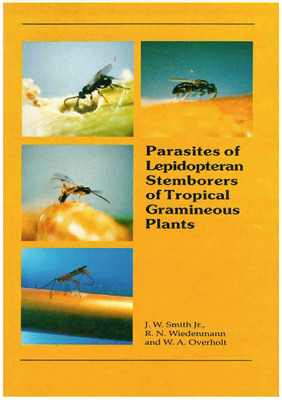
Parasites of Lepidopteran Stemborers of Tropical Gramineous Plants
J. W. Smith, R. N. Wiedenmann, and W. A. Overholt
Preface
This publication is primarily intended for biological control practitioners in the tropics, particularly those involved in managing stemborers of gramineous crops. It includes not only information gleaned from the scientific literature, but also draws on the experiences and personal knowledge the authors have gained through years of involvement with biological control of stemborers.
A wealth of information on the biology and ecology of both stemborers and their parasites — as well as tritrophic-level interactions between plants, pests and parasites — is included in the text. Particular attention is given to the generalized hierarchical steps involved in successful parasitization and to the various foraging strategies employed by stemborer parasites. A user-friendly key that incorporates parasite biology and taxonomy is provided to help the user determine the foraging strategy used by the parasites. The key encompasses the primary parasites that are most likely to be encountered when sampling stemborers. The key is not intended to be all inclusive, but rather is a guide that is restricted to those taxa most likely to be found. The intent of the key is to provide tentative identification of the parasite to a useable level, by maximizing the use of ecological information and observational skills, while minimizing taxonomic expertise. Rearing techniques, which acquire their foundation from the foraging strategies, are addressed in the last half of the text.
This publication is intended to be a fairly detailed review of stemborers and their parasites, but is not meant to be the final word. Rather, we intend this to be an initial attempt towards organizing the available information on stemborer parasites in a generalized structure that emphasizes the tritrophic interactions between a gramineous plant, a stemborer, and its parasite. Emphasis is placed on grouping parasites into similar foraging strategies to provide a biological structure for understanding the relationships between taxonomy and biology. Thus, the tables listing parasite genera and the text references to parasite species are not all-inclusive, but representative of the taxa likely to be encountered in field surveys for stemborer natural enemies.
The broad presentation of material has been followed because the authors feel strongly that a basic knowledge of the biology of the hosts and parasites is a prerequisite to pursuit of biological control, and that this basic knowledge is the foundation for successful biological control intervention. Without first presenting the basic knowledge of plant-host-parasite biology and ecology, this publication would result in no more than a cookbook for rearing parasites with limited application. Moreover, we demonstrate that, by knowing the biology and taxonomy of the hosts and parasites, certain generalizations can be made regarding foraging strategies and appropriate rearing procedures. Through the application of these generalizations, practitioners should acquire the knowledge necessary to make field collections of parasites and rear them, regardless of whether specific methods for rearing that species are included. However, whenever generalizations are made there will be exceptions. We have attempted to point out these exceptions whenever possible, but the readers will undoubtedly discover others. The references supplied at the end of sections are not intended to be exhaustive, but rather represent suggested reading for specific information on the subject. Often, citations are made in the text to direct the reader specifically. We have attempted to minimize citations in the text to save space. Undoubtedly we should have made more citations to document the wealth of outstanding information in the literature. We apologize in advance for those omissions.
Funded by:
Directorate General for International Cooperation (DGIS), Ministry of Foreign Affairs, The Hague, Netherlands and the Texas Agricultural Experiment Station.
Printing is not supported at the primary Gallery Thumbnail page. Please first navigate to a specific Image before printing.