-
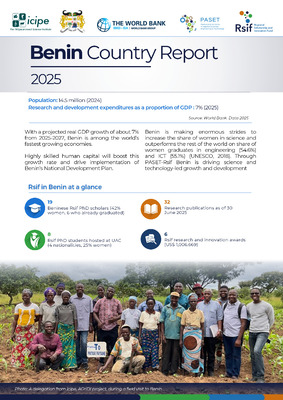
Rsif Benin Country Report 2025 - English
Regional Scholarship and Innovation Fund (Rsif)
Benin is among the world’s fastest growing economies. Highly skilled human capital will boost this growth rate and drive implementation of Benin’s National Development Plan. Benin is one of the nine African countries that is contributing to the Regional Scholarship and Innovation Fund (Rsif) of the Partnership for skills in Applied Sciences, Engineering and Technology (PASET) since 2021. Its contribution is USD 2 million to train Beninese PhD students in selected African host universities and collaborating with international partner institutions. Through PASET-Rsif Benin will build strong institutions and future science leaders to drive a science and technology-led growth and development. There are 19 Beninese Rsif PhD scholars (42% women). University of Abomey-Calavi, one of the 15 Rsif African Host Universities, is hosting 8 Rsif funded PhD students (25% women, 4 nationalities). There are 32 research publications (as of 30 June 2025). Six Rsif research and innovation projects are under implementation in Benin. icipe in partnership with UAC leads the “Accelerating Inclusive Green Growth through Agri-based Digital Innovation in West Africa (AGriDI)” initiative. The report turns the spotlight on Beninese Rsif scholars and highlights examples of their innovative research on biosecurity to enhance poultry farming, as well as how to turn water hyacinth from a devastating invader into an energy solution.
-
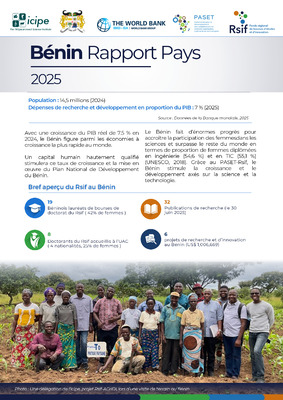
Rsif Bénin Rapport Pays 2025 - French
Regional Scholarship and Innovation Fund (Rsif)
Le Bénin figure parmi les économies connaissant la croissance la plus rapide au monde. Un capital humain hautement qualifié stimulera ce taux de croissance et favorisera la mise en œuvre du Plan national de développement du pays. Le Bénin est l'un des neuf pays africains qui contribuent au Fonds Régional de Bourses d’études et d'Innovations (Rsif) du Partenariat pour le Développement des Compétences en Sciences Appliquées, Ingénierie et Technologies (PASET) depuis 2021. Sa contribution s’élève à 2 millions de dollars destinées à la formation des doctorants béninois dans des universités d’accueil africaines sélectionnées et en collaboration avec des institutions partenaires internationales. Grâce au PASET-Rsif, le Bénin bâtira des institutions solides et de futurs leaders scientifiques pour stimuler une croissance et un développement axés sur la science et la technologie. Il y a 19 doctorants Rsif béninois sélectionnés par concours (42% de femmes). L'Université d'Abomey-Calavi (UAC), l’une des 15 universités d’acceuil africaines de Rsif, accueille 8 doctorants financés par le Rsif (25% de femmes, 4 nationalités). Il y 32 publications de recherche (le 30 juin 2025). Il y six projets de recherche et de l'innovation en cours de mise en œuvre au Bénin. icipe en partenariat avec UAC dirige l’initiative Accélérer la croissance verte inclusive grâce à l'innovation numérique basée sur l'agriculture en Afrique de l'Ouest (AGriDI). Le rapport met en lumière les chercheurs beninois du Rsif et met en lumière des exemples de leurs recherches innovantes sur la biosécurité pour améliorer l'aviculture, ainsi que la manière de transformer la jacinthe d'eau, un envahisseur dévastateur, en une solution énergétique.
-
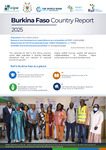
Rsif Burkina Faso Country Report 2025 - English
Regional Scholarship and Innovation Fund (Rsif)
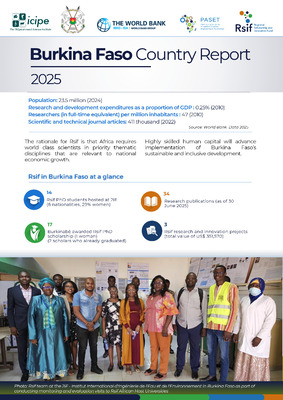
The rationale for Rsif is that Africa requires world class scientists in priority thematic disciplines that are relevant to national economic growth. Highly skilled human capital will advance implementation of Burkina Faso’s sustainable and inclusive development. Burkina Faso is one of the nine African countries that has contributed to the Regional Scholarship and Innovation Fund (Rsif) of the Partnership for skills in Applied Sciences, Engineering and Technology (PASET) since 2020. Its contribution of USD 2 million was through the World Bank supported Africa Centres of Excellence for Higher Education for Development Impact (ACE Impact) project and to train Burkinabè PhD students in selected African host universities and collaborating with international partner institutions. Through PASET-Rsif Burkina Faso will build strong institutions and future science leaders to drive a science and technology-led growth and development. The Institut International d'Ingénierie de l'Eau et de l'Environnement (2iE), one of the 15 Rsif African Host Universities, is hosting 14 Rsif PhD Students (6 nationalities, 29% women) and there are 3 Rsif research and innovation projects in Burkina Faso. There are 17 Rsif students from Burkina Faso and 34 research publications (as of 30 June 2025). The report puts the spotlight on Rsif students from Burkina Faso including how their research sheds light on sustainable farming practices and how AI and drones can be harnessed for smarter cities.
-
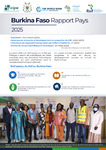
Rsif Burkina Faso Country Report 2025 - French
Regional Scholarship and Innovation Fund (Rsif)
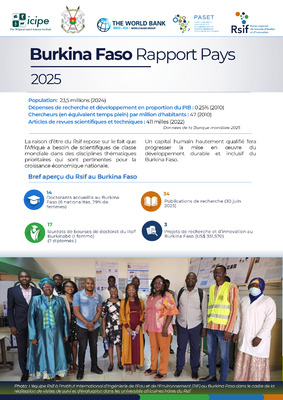
La raison d’être du Rsif repose sur le fait que l’Afrique a besoin de scientifiques de classe mondiale dans des disciplines thématiques prioritaires qui sont pertinentes pour la croissance économique nationale. Un capital humain hautement qualifié fera progresser la mise en œuvre du développement durable et inclusif du Burkina Faso. Le Burkina Faso est l'un des neuf pays africains qui contribuent au Fonds Régional de Bourses d’études et d'Innovations (Rsif) du Partenariat pour le Développement des Compétences en Sciences Appliquées, Ingénierie et Technologies (PASET) depuis 2020. Sa contribution est de 2 millions de dollars, financé par le projet de Centres d’excellence d’éducation supérieure africains pour un impact sur le développement (CEA Impact), destinées à la formation des doctorants burkinabè dans des universités d’accueil africaines sélectionnées et en collaboration avec des institutions partenaires internationales. Grâce au PASET-Rsif, le Burkina Faso bâtira des institutions solides et de futurs leaders scientifiques pour stimuler une croissance et un développement axés sur la science et la technologie. L’Institut International d'Ingénierie de l'Eau et de l'Environnement (2iE), l’une des 15 universités d’acceuil africaines de Rsif, acceuille 14 doctorants financés par le Rsif (29% de femmes, 6 nationalités) et il y a 3 projets Rsif de recherche et de l’innovation au Burkina Faso. Il y a 17 doctorants ressortissants du Burkina Faso et 32 publications de recherche (le 30 juin 2025) Le rapport met en lumière les chercheurs burkinabe du Rsif, notamment comment leurs recherches éclairent les pratiques agricoles durables et comment l'IA et les drones peuvent être mis à profit pour des villes intelligentes.
-
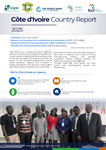
Rsif Côte d'Ivoire Country Report 2025 - English
Regional Scholarship and Innovation Fund (Rsif)
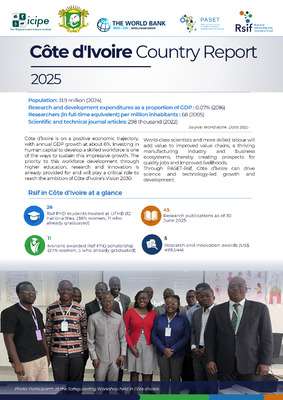
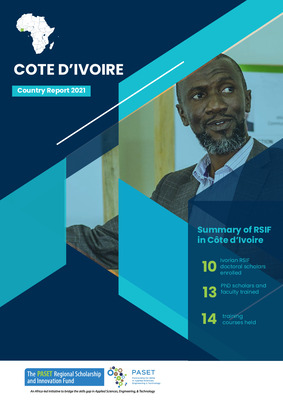
Côte d’Ivoire is on a positive economic trajectory, with annual GDP growth at about 6%. Investing in human capital to develop a skilled workforce is one of the ways to sustain this impressive growth. Côte d’Ivoire is one of nine African countries investing in the Regional Scholarship and Innovation Fund (Rsif) of the Partnership for skills in Applied Sciences, Engineering and Technology (PASET), since 2019. Its initial contribution of USD 1 million is used to train Ivorian PhD students in selected African host universities and collaborating international partner institutions. Through PASET-Rsif, Côte d’Ivoire will build strong institutions and future science leaders to drive a science and technology-led growth and development. University Félix Houphouët-Boigny (UFHB), one of the 15 Rsif African Host Universities, is hosting 26 Rsif PhD students (38% women, 12 nationalities). There are 45 research publications (as of 30 June 2025) and 5 Rsif research and innovation projects in Côte d’Ivoire. The report turns the spotlight on Ivorian Rsif scholars and highlights examples of how their research contributes to tackling cashew fungal diseases in Côte d’Ivoire; and improving livestock health and productivity in tse-tse infested areas in West Africa.
-
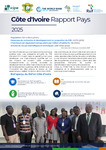
Rsif Côte d'Ivoire Country Report 2025 - French
Regional Scholarship and Innovation Fund (Rsif)
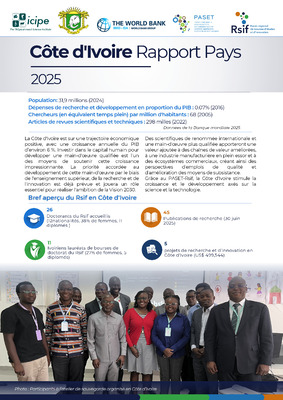
La Côte d'Ivoire est sur une trajectoire économique positive, avec une croissance annuelle du PIB d’environ 6 %. Investir dans le capital humain pour développer une main-d'œuvre qualifiée est l'un des moyens de soutenir cette croissance impressionnante. La Côte d'Ivoire est l'un des neuf pays africains qui contribuent au Fonds Régional de Bourses d’études et d'Innovations (Rsif) du Partenariat pour le Développement des Compétences en Sciences Appliquées, Ingénierie et Technologies (PASET) depuis 2019. Sa contribution initiale de 1 million de dollars est destinée à la formation des doctorants ivoiriens dans des universités d’accueil africaines sélectionnées et en collaboration avec des institutions partenaires internationales. Grâce au PASET-Rsif, la Côte d'Ivoire bâtira des institutions solides et de futurs leaders scientifiques pour stimuler une croissance et un développement axés sur la science et la technologie. L’Université Félix Houphouët-Boigny, l’une des 15 universités d’acceuil africaines de Rsif, accueille 26 doctorants financés par le Rsif (38% de femmes, 12 nationalités). Il y 45 publications de recherche (le 30 juin 2025) et 5 projets Rsif de recherche et de l’innovation en Côte d’Ivoire. Le rapport met en lumière les chercheurs ivoiriens du Rsif et souligne comment leurs recherches contribuent à lutter contre les maladies fongiques de l’anacardier en Côte d’Ivoire ; et à améliorer la santé et la productivité du bétail dans les zones infestées par le tsé-tsé en Afrique de l’Ouest.
-
Rsif Ethiopia Country Report 2025
Regional Scholarship and Innovation Fund (Rsif)
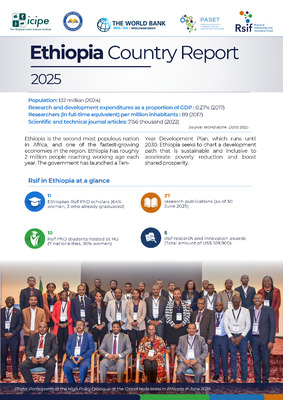
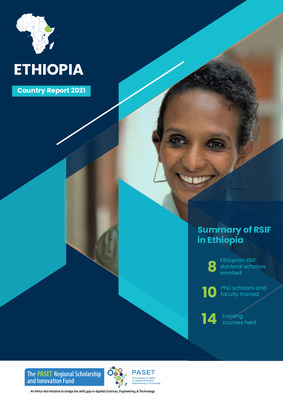
Ethiopia is the second most populous nation in Africa, and one of the fastest-growing economies in the region. Ethiopia has roughly 2 million people reaching working age each year. The government has launched a Ten-Year Development Plan, which runs until 2030. Ethiopia seeks to chart a development path that is sustainable and inclusive to accelerate poverty reduction and boost shared prosperity. Ethiopia is a founding member of the Partnership for skills in Applied Sciences, Engineering and Technology (PASET), and have expressed its intention to invest through the PASET flagship programme, the Regional Scholarship and Innovation Fund (Rsif). Rsif provides benefits to Ethiopia by supporting the building of strong institutions and training the future leaders in the applied sciences, engineering, and technology to drive a science and knowledge-led agenda. Haramaya University is one of the Rsif African Host Universities. There are 10 Rsif PhD students hosted in Ethiopia (7 nationalities, 30% women) and 5 Rsif research and innovation awards granted to Ethiopian scholars. 11 Ethiopian nationals have been awarded Rsif scholarship (64% women) and there are 37 research publications by the Rsif students as of 30 June 2025. The report turns the spotlight on Ethiopian Rsif scholars, including the ground-breaking work of a female scientist on high-quality, low-energy cement that could transform the construction industry. We also highlight Ethiopia’s work to bridge policy and practice in its higher education sector.
-
Rsif Ghana Country Report 2025
Regional Scholarship and Innovation Fund (Rsif)
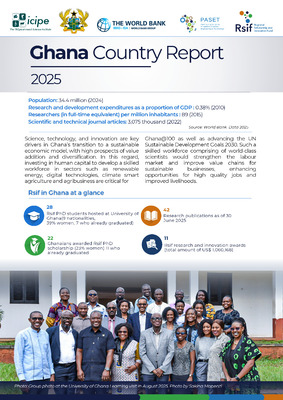
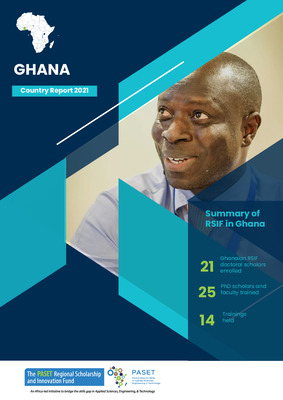
Science, technology, and innovation are key drivers in Ghana’s transition to a sustainable economic model, with high prospects of value addition and diversification. Ghana is one of the nine African countries that is contributing to the Regional Scholarship and Innovation Fund (Rsif) of the Partnership for skills in Applied Sciences, Engineering and Technology (PASET) since 2019. Its contribution is USD 2 million to train Ghanaian PhD students in selected African host universities and collaborating with international partner institutions. Through PASET-Rsif, Ghana is building strong institutions and future science leaders to drive a science and technology-led growth and development. University of Ghana, one of the 15 Rsif African Host Universities, is hosting 28 Rsif funded PhD students (9 nationalities, 39% women). There are 22 Ghanaian Rsif PhD students (23% women) and 42 research publications as of 30 June 2025. There are 11 Rsif research and innovation projects in Ghana. The report turns the spotlight on Ghanaian Rsif Scholars, highlighting a scholar who champions livelihood diversification for youth in coastal fishing communities and how the University of Ghana is strengthening innovation and technology transfer.
-
Rsif Kenya Country Report 2025
Regional Scholarship and Innovation Fund (Rsif)
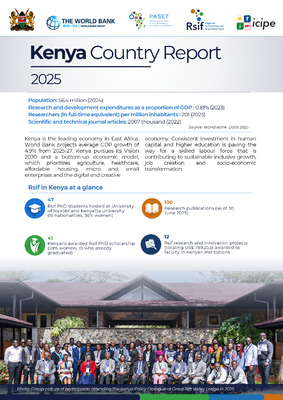
Kenya is the leading economy in East Africa. World Bank projects average GDP growth of 4.9% from 2025-27. Kenya pursues its Vision 2030 and a bottom-up economic model, which prioritizes agriculture, healthcare, affordable housing, micro and small enterprises, and the digital and creative economy. Consistent investment in human capital and higher education is paving the way for a skilled labour force that is contributing to sustainable inclusive growth, job creation and socio-economic transformation. Kenya is one of the nine African countries that is contributing to the Regional Scholarship and Innovation Fund (Rsif) of the Partnership for skills in Applied Sciences, Engineering and Technology (PASET) since 2017. Its contribution is USD 4 million to train Kenyan PhD students in selected African host universities and collaborating with international partner institutions. Through PASET-Rsif Kenya is building strong institutions and future science leaders to drive a science and technology-led growth and development. Kenya is the former chair of PASET and hosts the International Centre for Insect Physiology and Ecology (icipe), the Rsif Regional Coordination Unit. University of Nairobi and Kenyatta University are among the 15 Rsif African Host Universities. There are 47 Rsif PhD students hosted in Kenya (15 nationalities, 36% women) and 12 Rsif research and innovation projects awarded to Kenyan institutions. 41 Kenyan nationals have been awarded Rsif scholarship (59% women) and there are 100 research publications by the Rsif students as of 30 June 2025. The report turns the spotlight on Kenyan Rsif scholars and highlights the relevance of doctoral education for driving Kenya’s knowledge economy.
-
Rsif Korea Country Report 2025
Regional Scholarship and Innovation Fund (Rsif)
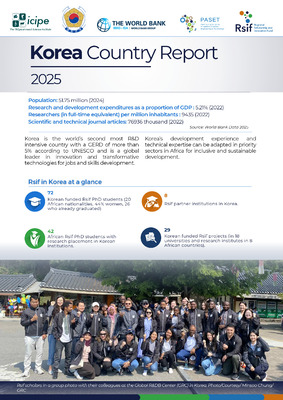
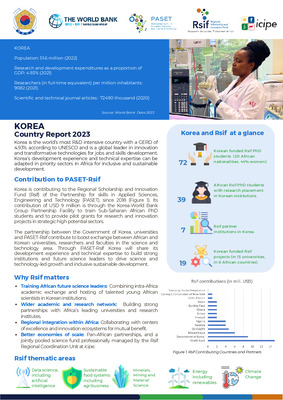
Korea is the world’s second most R&D intensive country with a GERD of more than 5% according to UNESCO and is a global leader in innovation and transformative technologies for jobs and skills development. Korea’s development experience and technical expertise can be adapted in priority sectors in Africa for inclusive and sustainable development. Korea is contributing to the Regional Scholarship and Innovation Fund (Rsif) of the Partnership for skills in Applied Sciences, Engineering and Technology (PASET), since 2018. Its contribution of USD 9 million is through the Korea-World Bank Group Partnership Facility to train Sub-Saharan African PhD students and to provide pilot grants for research and innovation projects in strategic high potential sectors. The partnership between the Government of Korea, universities and PASET-Rsif contributes to boost exchange between African and Korean universities, researchers and faculties in the science and technology area. Through PASET-Rsif Korea is sharing its development experience and technical expertise to build strong institutions and future science leaders to drive science and technology-led growth and inclusive sustainable development. There are 72 Korean funded Rsif scholars (20 nationalities, 44% women, 26 who already graduated) and 29 Korean funded projects (in 18 universities, in 8 countries). 42 Rsif scholars have research placement in 8 partner institutions in Korea. The report turns the spotlight on African Rsif scholars in Korea and their research contribution to sustainable development.
-
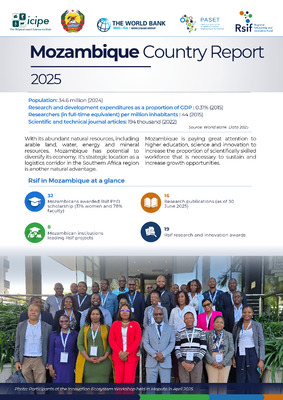
Rsif Mozambique Country Report 2025 - English
Regional Scholarship and Innovation Fund (Rsif)
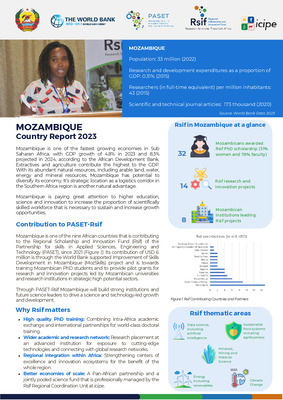
With its abundant natural resources, including arable land, water, energy and mineral resources, Mozambique has potential to diversify its economy. It’s strategic location as a logistics corridor in the Southern Africa region is another natural advantage. Mozambique is paying great attention to higher education, science and innovation to increase the proportion of scientifically skilled workforce that is necessary to sustain and increase growth opportunities.
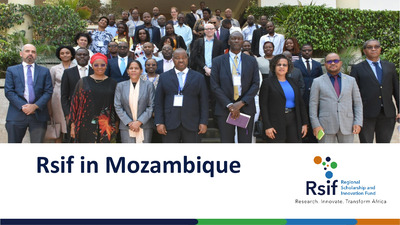
Mozambique is one of the nine African countries that is contributing to the Regional Scholarship and Innovation Fund (Rsif) of the Partnership for skills in Applied Sciences, Engineering and Technology (PASET), since 2021. Its contribution of USD 6 million is through the World Bank supported Improvement of Skills Development in Mozambique (MozSkills) project and is towards training Mozambican PhD students and to provide grants for research and innovation projects led by Mozambican universities and research institutions in strategic high potential sectors. Through PASET-Rsif Mozambique is building strong institutions and future science leaders to drive a science and technology-led growth and development. There are 32 Mozambicans awarded Rsif PhD scholarship (31% women and 78% faculty). 19 research and innovation grants have been awarded to Mozambican scholars. There are 16 research publications (as of 30 June 2025). The report turns the spotlight on Mozambican scholars and highlights research on aquaponic food systems and also how Student Startups Take Root in Instituto Superior Politecnico de Manica (ISPM) with MozSkills support.
-
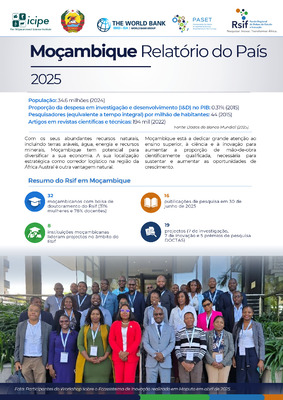
Rsif Mozambique Country Report 2025 - Portuguese
Regional Scholarship and Innovation Fund (Rsif)
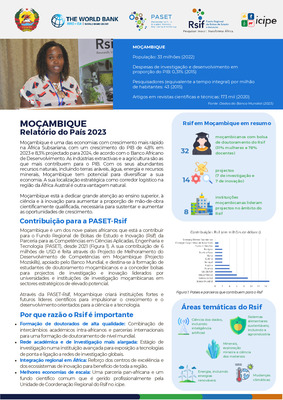
Com os seus abundantes recursos naturais, incluindo terras aráveis, água, energia e recursos minerais, Moçambique tem potencial para diversificar a sua economia. A sua localização estratégica como corredor logístico na região da África Austral é outra vantagem natural. Moçambique está a dedicar grande atenção ao ensino superior, à ciência e à inovação para aumentar a proporção de mão-de-obra cientificamente qualificada, necessária para sustentar e aumentar as oportunidades de crescimento. Moçambique é um dos nove países africanos que está a contribuir para o Fundo Regional de Bolsas de Estudo e Inovação (Rsif) da Parceria para as Competências em Ciências Aplicadas, Engenharia e Tecnologia (PASET), desde 2021. A sua contribuição de 6 milhões de USD é feita através do Projecto de Melhoramento do Desenvolvimento de Competências em Moçambique (Projecto Mozskills), apoiado pelo Banco Mundial, e destina-se à formação de estudantes de doutoramento moçambicanos e a conceder bolsas para projectos de investigação e inovação liderados por universidades e instituições de investigação moçambicanas emsectores estratégicos de elevado potencial. Através da PASET-Rsif, Moçambique criará instituições fortes e futuros líderes científicos para impulsionar o crescimento e o desenvolvimento orientadospara a ciência e a tecnologia. Há 32 moçambicanos com bolsa de doutoramento do Rsif (31% mulheres e 78% docentes). Foram concedidas 19 bolsas de investigação e inovação a académicos moçambicanos. Existem 16 publicações de investigação (em 30 de junho de 2025). O relatório destaca os estudantes moçambicanos e destaca a investigação sobre sistemas alimentares aquapónicos e também como as startups estudantis se enraízam no Instituto Superior Politécnico de Manica (ISPM) com o apoio da MozSkills.
-
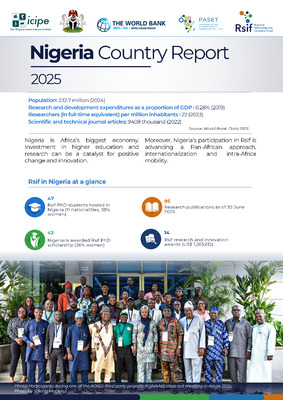
Rsif Nigeria Country Report 2025
Regional Scholarship and Innovation Fund (Rsif)
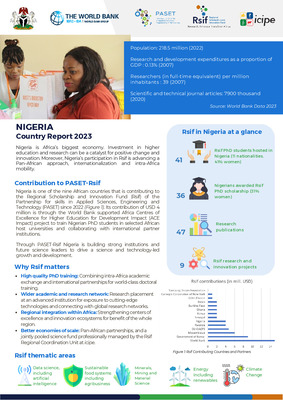
Nigeria is Africa’s biggest economy. Investment in higher education and research can be a catalyst for positive change and innovation. Moreover, Nigeria’s participation in Rsif is advancing a Pan-African approach, internationalization and intra-Africa mobility. Nigeria is one of the nine African countries that is contributing to the Regional Scholarship and Innovation Fund (Rsif) of the Partnership for skills in Applied Sciences, Engineering and Technology (PASET) since 2022. Its contribution of USD 4 million is through the World Bank supported Africa Centres of Excellence for Higher Education for Development Impact (ACE Impact) project, to train Nigerian PhD students in selected African host universities and collaborating with international partner institutions. Through PASET-Rsif Nigeria is building strong institutions and future science leaders to drive a science and technology-led growth and development. The African University of Science and Technology (AUST) in Abuja, Bayero University Kano (BUK) and University of Port Harcourt (UniPort) are among the 15 Rsif African Host Universities. There are 47 Rsif PhD students hosted in Nigeria (11 nationalities, 38% women) and 14 Rsif research and innovation awards in Nigeria. 43 Nigerians have been awarded Rsif PhD scholarship (26% women) and there are 95 research publications by the Rsif students (as of 30 June 2025). The report turns the spotlight on Nigerian Rsif Scholars, highlighting how one scholar’s work on nano-composites offer a cleaner future and how the University of Port Harcourt leads an innovation drive, strengthening institutional infrastructure for an innovation ecosystem.
-
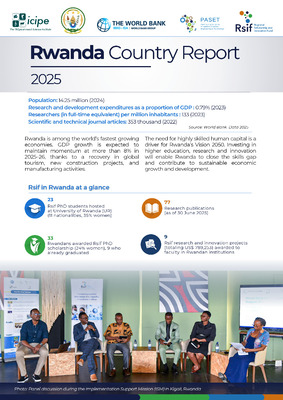
Rsif Rwanda Country Report 2025
Regional Scholarship and Innovation Fund (Rsif)
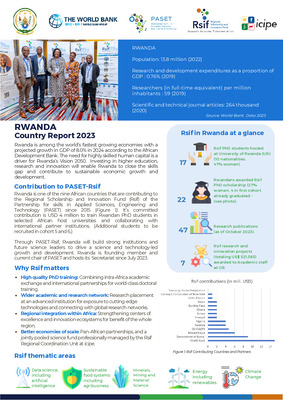
Rwanda is among the world’s fastest growing economies. GDP growth is expected to maintain momentum at more than 8% in 2025–26, thanks to a recovery in global tourism, new construction projects, and manufacturing activities. The need for highly skilled human capital is a driver for Rwanda’s Vision 2050. Investing in higher education, research and innovation will enable Rwanda to close the skills gap and contribute to sustainable economic growth and development. Rwanda is one of the nine African countries that are contributing to the Regional Scholarship and Innovation Fund (Rsif) of the Partnership for skills in Applied Sciences, Engineering and Technology (PASET) since 2015. It’s committed contribution is USD 4 million to train Rwandan PhD students in selected African host universities and collaborating with international partner institutions. Through PASET-Rsif, Rwanda is building strong institutions and future science leaders to drive a science and technology-led growth and development. Rwanda is founding member and current chair of PASET and hosts its Secretariat since July 2023 University of Rwanda, one of the 15 Rsif African Host Universities, is hosting 23 Rsif funded PhD students (11 nationalities, 35% women). There are 33 Rwandan Rsif PhD students (24% women) and 77 research publications as of 30 June 2025. There are 9 Rsif research and innovation projects in Rwanda. The report turns the spotlight on Rwandan Rsif Scholars and highlights AI and Big Data gains at University of Rwanda. Rwanda is ranking among the top three in Africa for AI utilization.
-
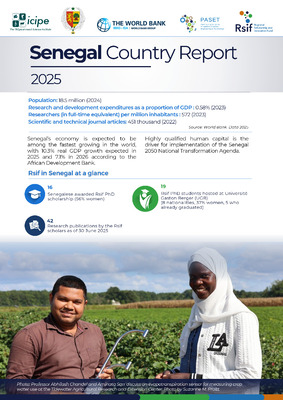
Rsif Senegal Country Report 2025
Regional Scholarship and Innovation Fund (Rsif)
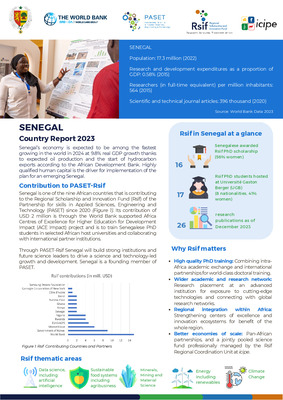
Senegal’s economy is expected to be among the fastest growing in the world, with 10.3% real GDP growth expected in 2025 and 7.1% in 2026 according to the African Development Bank. Highly qualified human capital is the driver for implementation of the Senegal 2050 National Transformation Agenda. Senegal is one of the nine African countries that is contributing to the Regional Scholarship and Innovation Fund (Rsif) of the Partnership for skills in Applied Sciences, Engineering and Technology (PASET) since 2020. Its contribution of USD 2 million is financed through the World Bank supported Africa Centres of Excellence for Higher Education for Development Impact (ACE Impact) project, to train Senegalese PhD students in selected African host universities and collaborating with international partner institutions. University Gaston Berger, one of the 15 Rsif African Host Universities, is hosting 19 Rsif funded PhD students (8 nationalities, 37% women). There are 16 Senegalese Rsif PhD students (56% women) and 42 research publications as of 30 June 2025. The report turns the spotlight on Senegalese Rsif scholars and highlights how Senegal is championing digital innovation as the Accelerating inclusive green growth through agri-based digital innovation (AGriDI) initiative closes with bold vision.
-
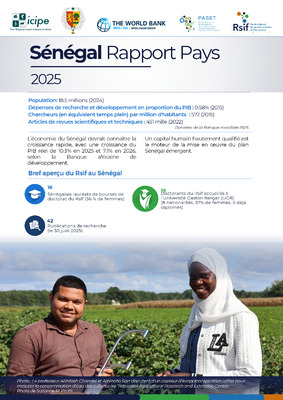
Rsif Sénégal Rapport Pays 2025 - French
Regional Scholarship and Innovation Fund (Rsif)
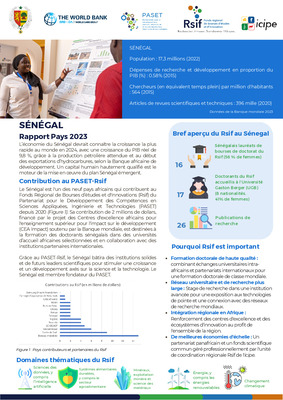
L’économie du Sénégal devrait connaître la croissance rapide, avec une croissance du PIB réel de 10.3% en 2025 et 7.1% en 2026, selon la Banque africaine de développement. Un capital humain hautement qualifié est le moteur de la mise en œuvre du plan Sénégal émergent. Le Sénégal est l'un des neuf pays africains qui contribuent au Fonds Régional de Bourses d’études et d'Innovations (Rsif) du Partenariat pour le Développement des Compétences en Sciences Appliquées, Ingénierie et Technologies (PASET) depuis 2020. Sa contribution de 2 millions de dollars est financé par le projet de Centres d’excellence d’éducation supérieure africains pour un impact sur le développement (CEA Impact), destinées à la formation des doctorants sénégalais dans des universités d’accueil africaines sélectionnées et en collaboration avec des institutions partenaires internationales. Grâce au PASET-Rsif, le Sénégal bâtira des institutions solides et de futurs leaders scientifiques pour stimuler une croissance et un développement axés sur la science et la technologie. L’Université Gaston Berger, l’une des 15 universités d’acceuil africaines de Rsif, accueille 19 doctorants financés par le Rsif (37% de femmes, 8 nationalités). Il y a 16 sénégalais lauréats de bourses de doctorat du Rsif (56% de femmes) Il y a 42 publications de recherche (le 30 juin 2025). Le rapport met en lumière les chercheurs sénégalais du Rsif et comment le Sénégal est un fervent défenseur de l'innovation numérique.
-
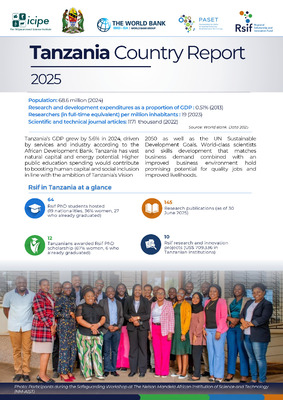
Rsif Tanzania Country Report 2025
Regional Scholarship and Innovation Fund (Rsif)
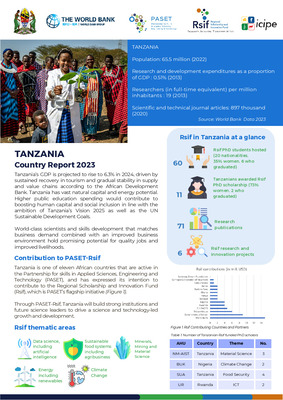
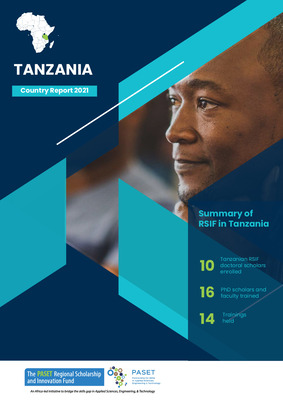
Tanzania’s GDP grew by 5.6% in 2024, driven by services and industry according to the African Development Bank. Tanzania has vast natural capital and energy potential. Higher public education spending would contribute to boosting human capital and social inclusion in line with the ambition of Tanzania’s Vision 2050 as well as the UN Sustainable Development Goals. World-class scientists and skills development that matches business demand combined with an improved business environment hold promising potential for quality jobs and improved livelihoods. Tanzania is one of eleven African countries that are active in the Partnership for skills in Applied Sciences, Engineering and Technology (PASET), and has expressed its intention to contribute to the Regional Scholarship and Innovation Fund (Rsif), which is PASET’s flagship initiative. Rsif provides benefits to Tanzania by supporting the building of strong institutions and training the future leaders in the applied sciences, engineering, and technology to drive a science and knowledge-led agenda. Sokoine University of Agriculture and Nelson Mandela African Institution of Science and Technology are Rsif African Host Universities. There are 64 Rsif PhD students in Tanzania (19 nationalities, 36% women). 12 Tanzanians were awarded Rsif PhD scholarship (67% women). There are 145 research publications as of 30 June 2025 and 10 research and innovation projects under implementation in Tanzania. The report turns the spotlight on Tanzania’s Rsif scholars, highlighting innovative research that boosts ozone protection and climate resilience, and a Tanzanian Rsif alumna who won international recognition through the UNESCO-L’Oréal for Women in Science Award.
-
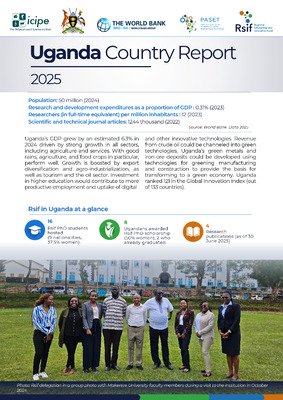
Rsif Uganda Country Report 2025
Regional Scholarship and Innovation Fund (Rsif)
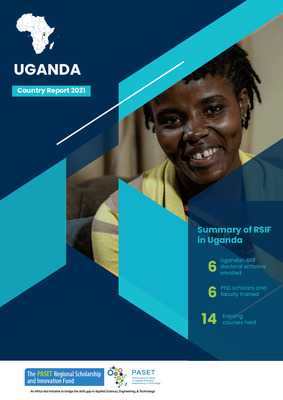
Uganda’s GDP grew by an estimated 6.3% in 2024 driven by strong growth in all sectors, including agriculture and services. Investment in higher education would contribute to more productive employment and uptake of digital and other innovative technologies. Revenue from crude oil could be channeled into green technologies. Uganda’s green metals and iron-ore deposits could be developed using technologies for greening manufacturing and construction to provide the basis for transforming to a green economy. Uganda is one of eleven African countries that are active in the Partnership for skills in Applied Sciences, Engineering and Technology (PASET), and has expressed its intention to contribute to the Regional Scholarship and Innovation Fund (Rsif), which is PASET’s flagship initiative. Rsif provides benefits to Uganda by supporting the building of strong institutions and training the future leaders in the applied sciences, engineering, and technology to drive a science and knowledge-led agenda. Makerere University is an Rsif African Host University. There are 16 Rsif PhD students in Uganda (9 nationalities, 37.5% women). 8 Ugandans were awarded Rsif PhD scholarship (50% women). There are 4 research publications to date. The report turns the spotlight on Uganda’s Rsif scholars and highlights strategic discussions held at Makerere University Regional Centre for Crop Improvement (MaRCCI).
-
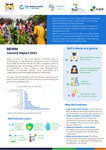
Rsif Benin Country Report 2023 - English
Regional Scholarship and Innovation Fund (Rsif)
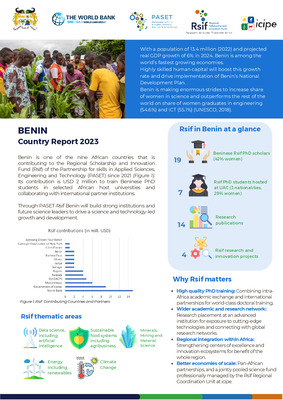
Benin is among the world’s fastest growing economies. Highly skilled human capital will boost this growth rate and drive implementation of Benin’s National Development Plan. Benin is one of the nine African countries that is contributing to the Regional Scholarship and Innovation Fund (Rsif) of the Partnership for skills in Applied Sciences, Engineering and Technology (PASET) since 2021. Its contribution is USD 2 million to train Beninese PhD students in selected African host universities and collaborating with international partner institutions. Through PASET-Rsif Benin will build strong institutions and future science leaders to drive a science and technology-led growth and development. There are 19 Beninese Rsif PhD scholars (42% women). University of Abomey-Calavi, one of the 15 Rsif African Host Universities, is hosting 7 Rsif funded PhD students (29% women, 3 nationalities). So far there are 14 research publications. Four Rsif research and innovation projects are under implementation in Benin. icipe in partnership with UAC leads the “Accelerating Inclusive Green Growth through Agri-based Digital Innovation in West Africa (AGriDI)” initiative. The report turns the spotlight on Beninese Rsif scholars and highlights how Rsif projects are strengthening resilience to climate change and Developing and scaling up digital innovations in agriculture.
-
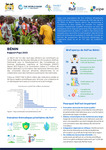
Rsif Benin CRapport pays 2023 - French
Regional Scholarship and Innovation Fund (Rsif)
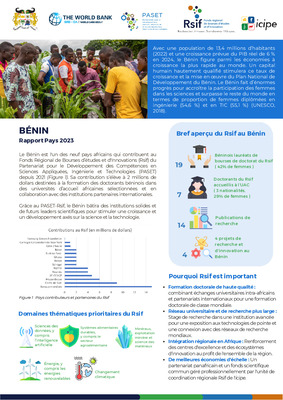
Le Bénin a apporté une contribution au Rsif de 2 millions de dollars en 2021. Il y a 20 doctorants Rsif béninois sélectionnés par concours (40% de femmes) dans les cinq domaines thématiques, dans neuf universités hôtes africaines différentes à travers le continent. Il y a déjà un diplômé Rsif ressortissant du Bénin et 7 publications par les doctorants béninois. L'Université d'Abomey-Calavi, Centre d’Excellence des Sciences, Mathématiques, Informatique et Applications (SMIA) a été sélectionnée de manière compétitive comme université hôte africaine du Rsif dans les TIC, y compris l'intelligence artificielle et la science des données. En 2022, le programme de doctorat en Technologies de l’Information et de la Communication de l’Institut de Mathématiques et de Sciences Physiques a admis huit étudiants financés par le Rsif provenant de trois pays différents. Il y a trois projets d'innovation numérique basée sur l'agriculture en cours de mise en œuvre au Bénin.
-
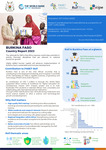
Rsif Burkina Faso Country Report 2023 - English
Regional Scholarship and Innovation Fund (Rsif)
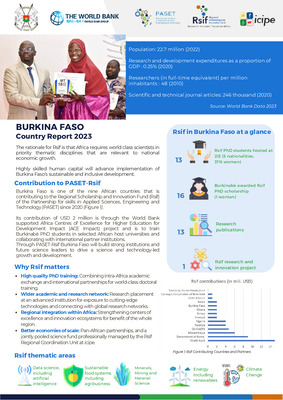
The rationale for Rsif is that Africa requires world class scientists in priority thematic disciplines that are relevant to national economic growth. Highly skilled human capital will advance implementation of Burkina Faso’s sustainable and inclusive development. Burkina Faso is one of the nine African countries that is contributing to the Regional Scholarship and Innovation Fund (Rsif) of the Partnership for skills in Applied Sciences, Engineering and Technology (PASET) since 2020. Its contribution of USD 2 million is through the World Bank supported Africa Centres of Excellence for Higher Education for Development Impact (ACE Impact) project and is to train Burkinabè PhD students in selected African host universities and collaborating with international partner institutions. Through PASET-Rsif Burkina Faso will build strong institutions and future science leaders to drive a science and technology-led growth and development.
There are 16 Burkinabè Rsif PhD scholars (1 woman, 15 men) registered in four thematic areas in seven different Rsif African host universities across the continent. Twelve of these started their studies in 2022.
Institut International d'Ingénierie de l'Eau et de l'Environnement (2iE) is hosting 13 Rsif funded PhD students (31% women, 5 nationalities) in its PhD programme in Sciences and Technologies of Water, Energy and the Environment since 2022. So far there are 17 research publications by Burkina Faso nationals and international scholars at 2iE. A Burkina Faso graduate has been awarded an Rsif-DOCTAS post-doc grant for the “Design of a forecasting system to optimize the operation of a PV power plant in Burkina Faso” funded by the Carnegie Corporation of New York. An Rsif project funded by the European Union’s ACP Innovation Fund on “Precision Pest and Disease Management System based on Multidimensional Big Data” is also under implementation in Burkina Faso.
-
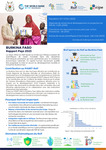
Rsif Burkina Faso Rapport pays 2023 - French
Regional Scholarship and Innovation Fund (Rsif)
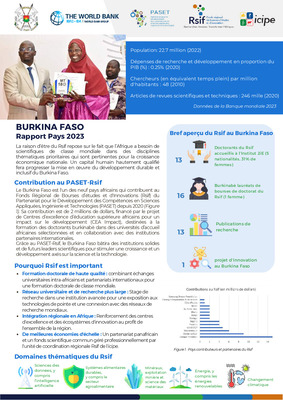
La raison d’être du Rsif repose sur le fait que l’Afrique a besoin de scientifiques de classe mondiale dans des disciplines thématiques prioritaires qui sont pertinentes pour la croissance économique nationale. Un capital humain hautement qualifié fera progresser la mise en œuvre du développement durable et inclusif du Burkina Faso. Le Burkina Faso est l'un des neuf pays africains qui contribuent au Fonds Régional de Bourses d’études et d'Innovations (Rsif) du Partenariat pour le Développement des Compétences en Sciences Appliquées, Ingénierie et Technologies (PASET) depuis 2020. Sa contribution est de 2 millions de dollars, financé par le projet de Centres d’excellence d’éducation supérieure africains pour un impact sur le développement (CEA Impact), destinées à la formation des doctorants burkinabè dans des universités d’accueil africaines sélectionnées et en collaboration avec des institutions partenaires internationales. Grâce au PASET-Rsif, le Burkina Faso bâtira des institutions solides et de futurs leaders scientifiques pour stimuler une croissance et un développement axés sur la science et la technologie. Il y a 16 Burkinabè lauréats de bourses de doctorat du Rsif (1 femme) inscrits dans quatre domaines thématiques dans sept universités hôtes africaines différentes à travers le continent. Douze d’entre eux ont commencé leurs études en 2022.
L’Institut International d'Ingénierie de l'Eau et de l'Environnement (2iE), accueille 13 doctorants financés par le Rsif (31% de femmes, 5 nationalités) dans son programme de doctorat en Sciences et Technologies de l’Eau, de l’Énergie et de l’Environnement. Il y a déjà 17 publications de recherche. Un diplômé du Burkina Faso a reçu une bourse postdoctorale Rsif-DOCTAS pour la « Conception d'un système de prévision pour optimiser le fonctionnement d'une centrale photovoltaïque au Burkina Faso » financée par la Carnegie Corporation de New York. Un projet Rsif financé par le Fonds d'Innovation ACP de l'Union européenne sur le "Système de gestion de précision des ravageurs et des maladies basés sur le Big Data multidimensionnel" est également en cours de mise en œuvre au Burkina Faso.
-
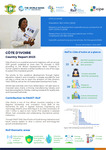
Rsif Côte d’Ivoire Country Report 2023 - English
Regional Scholarship and Innovation Fund (Rsif)
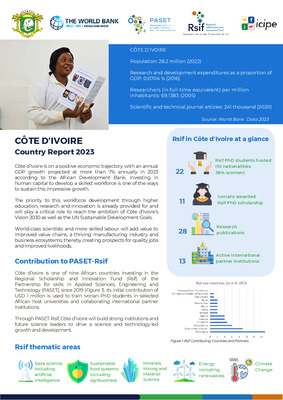
Côte d’Ivoire is on a positive economic trajectory, with an annual GDP growth projected at more than 7% annually in 2023 according to the African Development Bank. Investing in human capital to develop a skilled workforce is one of the ways to sustain this impressive growth. Côte d’Ivoire is one of the nine African countries that is contributing to the Regional Scholarship and Innovation Fund (Rsif) of the Partnership for skills in Applied Sciences, Engineering and Technology (PASET) since 2019. Its initial contribution is USD 1 million to train Ivorian PhD students in selected African host universities and collaborating with international partner institutions. Through PASET-Rsif, Côte d’Ivoire will build strong institutions and future science leaders to drive a science and technology-led growth and development. The Université Félix Houphouët-Boigny, one of the 15 Rsif African host universities, is hosting 22 Rsif PhD students (10 nationalities, 36% women). There are 11 Ivorian Rsif PhD scholars and 28 research publications to date. The report turns the spotlight on Ivorian Rsif scholars and highlights how an Rsif innovation project is reducing post-harvest losses and opening international markets for Ivorian producers.
-
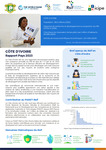
Rsif Côte d’Ivoire Rapport pays 2023 - French
Regional Scholarship and Innovation Fund (Rsif)
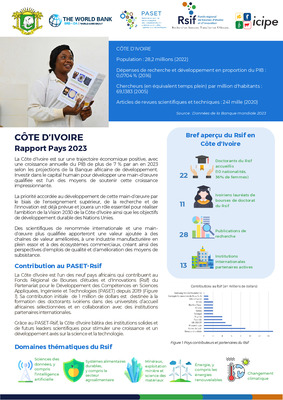
La Côte d'Ivoire est sur une trajectoire économique positive, avec une croissance annuelle du PIB de plus de 7 % par an en 2023 selon les projections de la Banque africaine de développement. Investir dans le capital humain pour développer une main-d'œuvre qualifiée est l'un des moyens de soutenir cette croissance impressionnante. La Côte d'Ivoire est l'un des neuf pays africains qui contribuent au Fonds Régional de Bourses d’études et d'Innovations (Rsif) du Partenariat pour le Développement des Compétences en Sciences Appliquées, Ingénierie et Technologies (PASET) depuis 2019. Sa contribution initiale de 1 million de dollars est destinée à la formation des doctorants ivoiriens dans des universités d’accueil africaines sélectionnées et en collaboration avec des institutions partenaires internationales. Grâce au PASET-Rsif, la Côte d'Ivoire bâtira des institutions solides et de futurs leaders scientifiques pour stimuler une croissance et un développement axés sur la science et la technologie. L’Université Félix Houphouët-Boigny, l’une des 15 universités d’acceuil africaines de Rsif, accueille 22 doctorants financés par le Rsif (36% de femmes, 10 nationalités). A ce jour il y a 28 publications de recherche. Le rapport met en lumière les chercheurs ivoiriens du Rsif et souligne comment un projet d’innovation du Rsif contribue à réduire les pertes après récolte et à ouvrir les marchés internationaux aux producteurs ivoiriens.
-
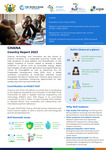
Rsif Ghana Country Report 2023
Regional Scholarship and Innovation Fund (Rsif)
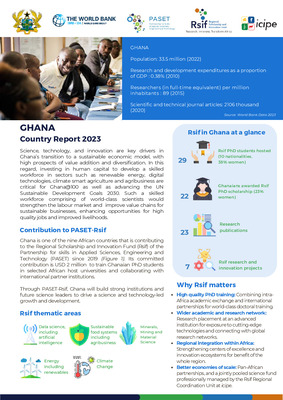
Science, technology, and innovation are key drivers in Ghana’s transition to a sustainable economic model, with high prospects of value addition and diversification. Ghana is one of the nine African countries that is contributing to the Regional Scholarship and Innovation Fund (Rsif) of the Partnership for skills in Applied Sciences, Engineering and Technology (PASET) since 2019. Its contribution of USD 2 million is through the World Bank supported Africa Centres of Excellence for Higher Education for Development Impact (ACE Impact) project, to train Ghanaian PhD students in selected African host universities and collaborating with international partner institutions. Through PASET-Rsif, Ghana will build strong institutions and future science leaders to drive a science and technology-led growth and development. University of Ghana is hosting 28 Rsif funded PhD students (9 nationalities, 39% women) in its PhD Program in Applied Agricultural and Policy/Agribusiness). There are 22 Ghanaian Rsif PhD students (22% women) including four who already graduated and 31 research publications to date. There are 8 Rsif research and innovation projects in Ghana.
Printing is not supported at the primary Gallery Thumbnail page. Please first navigate to a specific Image before printing.